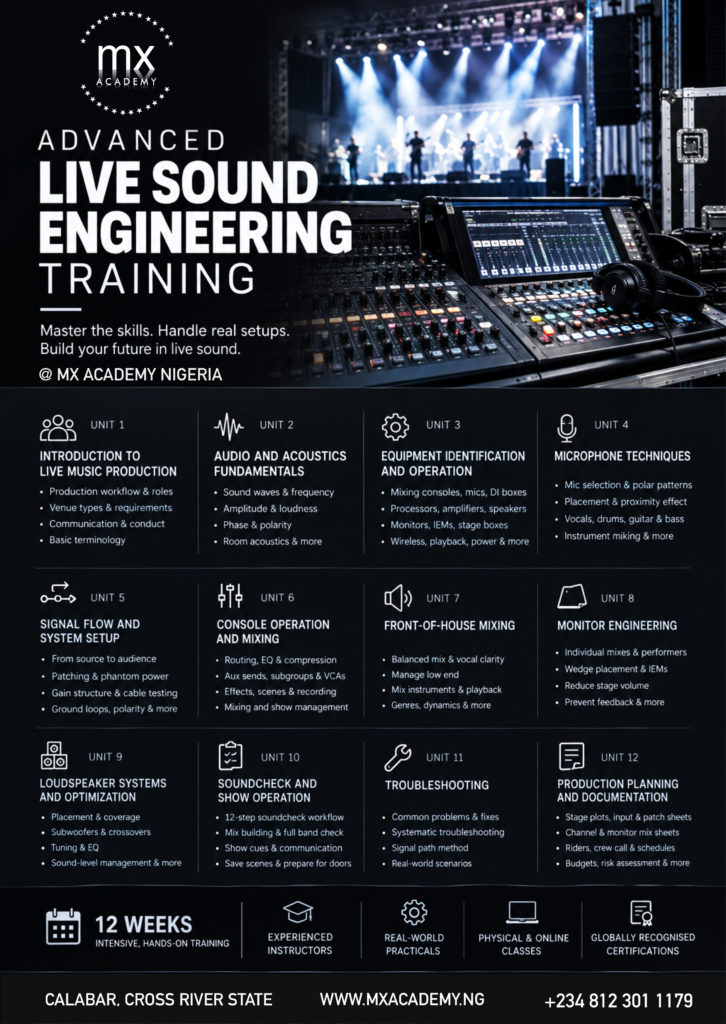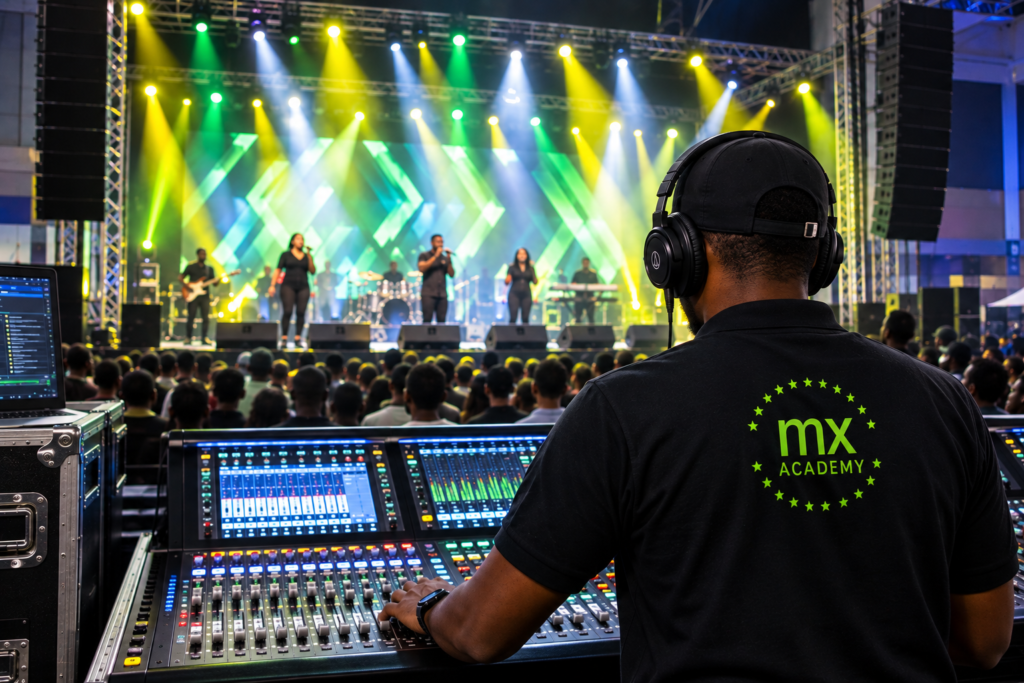
Advanced Live Sound Engineering & Live Music Production Training at
Course Outline
Course Duration: 12 weeks
Level: Beginner to Advanced
Prerequisites: Basic computer literacy and an interest in music, audio, or event production
Course Description
This course introduces students to the technical and creative processes involved in producing live music events. Students learn audio fundamentals, signal flow, microphones, mixing consoles, PA systems, monitor mixing, stage management, system setup, troubleshooting, and live-show production. The course emphasizes practical experience and culminates in the planning and execution of a live performance.
Learning Outcomes
By the end of the course, students should be able to:
- Explain the principles of sound, acoustics, gain structure, and signal flow.
- Identify and correctly use common microphones, DI boxes, cables, speakers, and audio equipment.
- Set up and dismantle a basic live sound system safely.
- Operate analog and digital mixing consoles.
- Create input lists, stage plots, patch sheets, and technical riders.
- Perform soundchecks efficiently.
- Mix front-of-house sound for a small live event.
- Create and manage monitor mixes.
- Apply equalization, compression, gating, effects, and feedback control.
- Troubleshoot common live audio problems.
- Coordinate musicians, stage crew, venue staff, and production personnel.
- Plan and produce a complete live music event.
Weekly Course Schedule
| Week | Topic | Key Content | Practical Activity |
|---|---|---|---|
| 1 | Introduction to Live Sound | Roles of the live sound engineer, production team, FOH, monitors, stage crew, and system technician | Identify equipment and analyze a live-event setup |
| 2 | Fundamentals of Sound | Frequency, amplitude, wavelength, phase, decibels, SPL, dynamic range, and human hearing | Use audio examples to identify frequency and level changes |
| 3 | Signal Flow and Gain Structure | Sources, preamps, inserts, buses, aux sends, outputs, gain staging, balanced and unbalanced connections | Trace signal flow through a complete sound system |
| 4 | Microphones and DI Boxes | Dynamic, condenser, ribbon, wired, wireless, polar patterns, microphone placement, DI operation | Mic a vocalist, acoustic guitar, drum kit, and amplifier |
| 5 | Cables, Connectors, and Stage Wiring | XLR, TRS, TS, speakON, patching, multicore systems, digital audio connections, cable care | Build and test a stage patch using an input list |
| 6 | Mixing Consoles | Channel strips, preamp gain, EQ, filters, dynamics, mute groups, VCA/DCA groups, scenes, and routing | Create a basic mix on an analog or digital console |
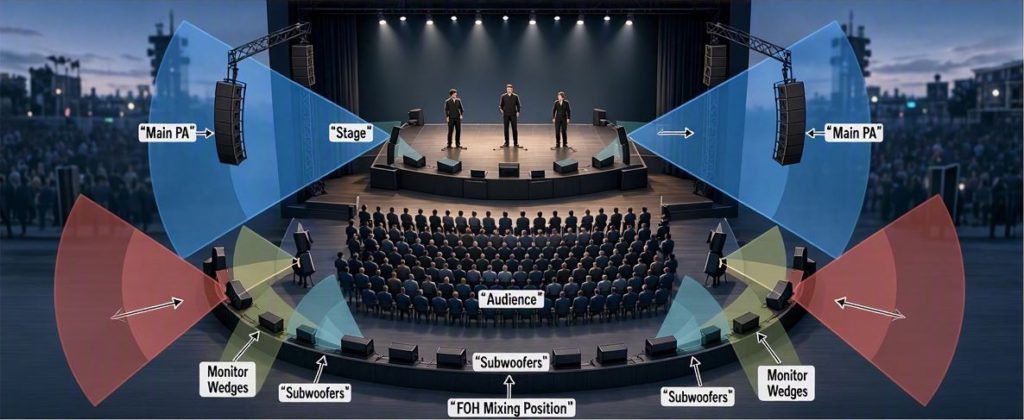
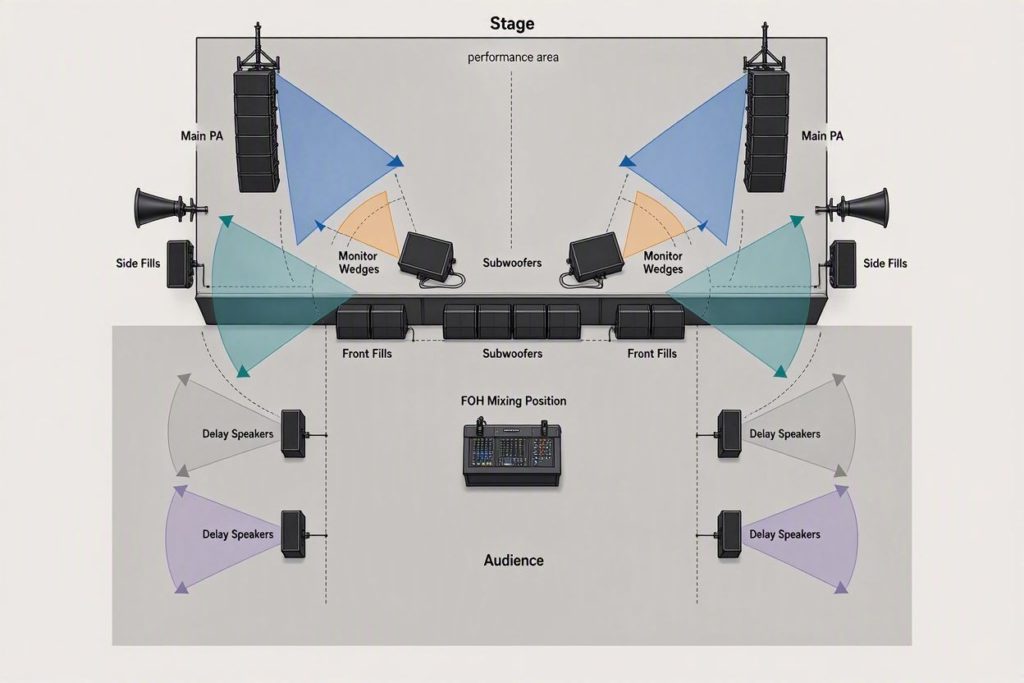
| 7 | PA Systems and Loudspeaker Design | Main speakers, subwoofers, monitors, amplifiers, powered speakers, coverage, crossover, delay, and system alignment | Set up a small PA and evaluate speaker coverage |
| 8 | Stage Monitoring | Wedge monitors, in-ear monitors, aux mixes, monitor etiquette, gain before feedback, and communication | Build separate monitor mixes for a band |
| 9 | Soundcheck and Live Mixing | Line checks, patch verification, virtual soundcheck, show files, mixing priorities, and engineer workflow | Conduct a complete band soundcheck |
| 10 | Processing and Feedback Control | EQ, compression, gates, limiters, reverb, delay, feedback identification, and corrective techniques | Process vocals, drums, bass, and instruments in a live mix |
| 11 | Live Music Production and Event Management | Production schedules, stage plots, input lists, technical riders, advancing, crew coordination, safety, and contingency planning | Prepare documents and a production plan for a live event |
| 12 | Final Live Production | Event setup, rehearsal, performance, changeovers, recording, documentation, and strike | Produce and operate a live music event |
Core Units
Unit 1: Introduction to Live Music Production
Topics include:
- The live production workflow
- Roles and responsibilities:
- Production manager
- FOH engineer
- Monitor engineer
- System engineer
- Stage manager
- Backline technician
- Lighting and video crew
- Venue types and production requirements
- Professional communication and workplace conduct
- Basic production terminology
Unit 2: Audio and Acoustics Fundamentals
Students study:
- Sound waves and frequency
- Amplitude and loudness
- Phase and polarity
- Harmonics and timbre
- Decibels and sound pressure level
- Frequency ranges of common instruments
- Room acoustics and reflections
- Noise, distortion, and dynamic range
Unit 3: Equipment Identification and Operation
Equipment covered:
- Mixing consoles
- Microphones
- DI boxes
- Signal processors
- Power amplifiers
- Main speakers and subwoofers
- Monitor speakers
- In-ear monitoring systems
- Stage boxes and multicore cables
- Wireless microphone systems
- Playback systems
- Power distribution equipment
Unit 4: Microphone Techniques
Students learn:
- Selecting microphones for different sources
- Polar patterns and proximity effect
- Microphone placement
- Vocal microphone technique
- Drum and percussion miking
- Guitar and bass amplifier miking
- Acoustic instrument miking
- Avoiding microphone bleed
- Handling and storage procedures
Unit 5: Signal Flow and System Setup
Students should be able to follow a signal from:
Sound source → microphone or DI → stage box → multicore or digital network → console input → processing → bus or aux → output → amplifier or powered speaker → audience
Practical topics include:
- Input and output patching
- Phantom power
- Gain structure
- Cable testing
- Ground loops
- Polarity checks
- Analog and digital signal flow
- Redundancy and backup planning
Unit 6: Console Operation and Mixing
Console skills include:
- Channel selection and routing
- Preamp gain
- High-pass filters
- Parametric EQ
- Compression
- Gates and expanders
- Aux sends
- Subgroups and matrices
- VCA/DCA control
- Mute groups
- Effects sends and returns
- Scene and show-file management
- Recording and playback routing
Unit 7: Front-of-House Mixing
Students practice:
- Establishing a balanced mix
- Setting vocal clarity and presence
- Managing low-frequency energy
- Mixing drums, bass, guitars, keyboards, and playback
- Creating a musical mix rather than simply increasing volume
- Handling changes in arrangement and dynamics
- Mixing different genres and performance styles
- Maintaining appropriate sound levels
Unit 8: Monitor Engineering
Topics include:
- Creating individual monitor mixes
- Understanding performer requirements
- Wedge placement
- In-ear monitor workflows
- Reducing stage volume
- Preventing monitor feedback
- Communicating with performers
- Managing monitor changes during a show
- Maintaining safe listening levels
Unit 9: Loudspeaker Systems and System Optimization
Students learn about:
- Speaker placement
- Coverage and dispersion
- Subwoofer arrangement
- Crossover points
- Speaker polarity
- Delay systems
- Amplifier and speaker matching
- System tuning
- Equalization of the PA
- Sound-level management
- Basic measurement tools
Unit 10: Soundcheck and Show Operation
A standard soundcheck workflow:
- Confirm the stage is safe and ready.
- Verify the patch and console file.
- Perform a line check.
- Check microphones and DI inputs.
- Set preamp gain.
- Check monitors.
- Tune individual channels.
- Build the front-of-house mix.
- Check the full band.
- Confirm show cues, playback, and communication.
- Save the console scene or show file.
- Prepare for doors and performance.
Unit 11: Troubleshooting
Common problems addressed:
- No signal
- Low or distorted signal
- Hum and buzz
- Intermittent cables
- Feedback
- Incorrect routing
- Phantom-power problems
- Wireless interference
- Phase and polarity issues
- Dead batteries
- Digital-network or clocking errors
- Speaker or amplifier failure
- Unexpected console changes
Students use a systematic troubleshooting process:
Source → cable → input → channel → bus → output → amplifier → speaker
Unit 12: Production Planning and Documentation
Students prepare:
- Stage plots
- Input lists
- Patch sheets
- Channel lists
- Monitor mix sheets
- Technical riders
- Equipment lists
- Crew call sheets
- Production schedules
- Changeover plans
- Risk assessments
- Event budgets
- Post-event reports
Unit 13: Safety
- Safe lifting and equipment handling
- Cable ramps and trip hazards
- Electrical safety
- Safe speaker and truss practices
- Hearing protection
- Working around crowds
- Weather protection for outdoor events
- Emergency procedures
- Safe use of ladders and access equipment
- Maintaining clear exits and walkways
- Appropriate sound exposure levels
Final Assignment: Live Event Production
In teams, students plan and deliver a live music performance. Responsibilities may include:
- Production coordination
- Stage management
- FOH mixing
- Monitor mixing
- System setup
- Artist liaison
- Documentation
- Recording
- Equipment strike
Suggested Final Competency
A student successfully completing the course should be able to prepare, set up, soundcheck, operate, troubleshoot, and dismantle a small live sound system for a band or event while working safely and communicating effectively with the production team.
Why Train at MX Academy?
- Practical, hands-on training
- Learn from experienced instructors
- Build confidence in real event situations
- Develop skills for concerts, studios, churches, events, and production companies
- Internationally recognized certifications.
Whether you are a beginner, musician, church sound operator, aspiring audio engineer,
or event professional, this training will help you take your skills to the next level.
Start your journey in live sound engineering today!
Delivery Format: Physical Class and Online Class
Duration: 12 Weeks
Registration: www.mxacademy.ng/register
Physical Class Location: Calabar, Cross River State
Contact: +234-8123 011 179.
www.mxacademy.ng
MX Academy — Learn the Sound. Control the Experience.
Click here to Register Now!